St. Paul's Hospital
A community of health, hope and compassion for all.
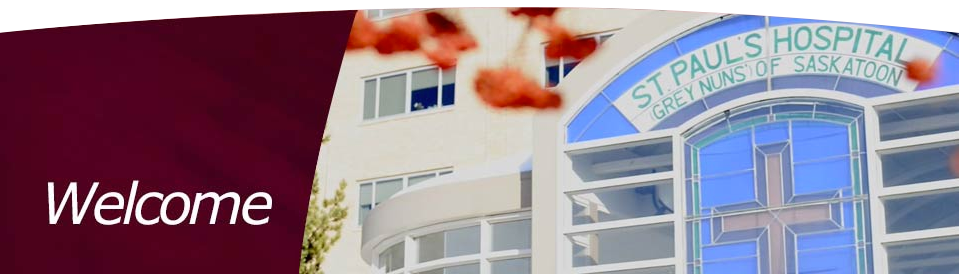
St. Paul's Hospital is an acute care teaching and applied research Hospital delivering compassionate and holistic care to the people of Saskatoon and Saskatchewan.
Owned by Emmanuel Health, St. Paul's Hospital is a Catholic Hospital with a rich history that was founded in 1907 by the Grey Nuns.
In 1996, St. Paul's became the first independently affiliated Hospital in Canada to manage health services in tandem with a regional authority. This partnership continues today as the Saskatchewan Health Authority and St. Paul's Hospital work in harmony to deliver services to people within our communities.
IMPORTANT INFORMATION
Front Entrance Construction
Construction began on the front entrance in November 2023 and will take approximately two years to complete. This project impacts access to the hospital as well as parking.
Click here for more information on how this impacts your visit to St. Paul's Hospital.
Patients coming to the hospital should factor in extra time, depending on their mobility. Changes to parking and hospital access points can mean some additional travel time to access Registration.
Non-emergent patients and visitors are now required to access the hospital via the west entrances on Avenue R. Patients and visitors coming to the hospital should factor in extra time, depending on their mobility. Changes to parking and hospital access points can mean additional travel time as well.
Please watch video for a detailed walk through: CLICK HERE
The emergency entrance is for emergencies only.
Please watch video a detailed walk through: CLICK HERE
St. Paul's Hospital Managed Programs
Through our unique partnership with Saskatchewan Health Authority, St. Paul’s Hospital is responsible for the governance and management of the following core programs in the region:
➔ Chronic Disease Management
➔ Diagnostic Imaging and Nuclear Medicine
➔ Ethics
➔ Emergency and Air Ambulance
➔ Kidney Health and Provincial Transplant
➔ Laboratory
➔ Mental Health and Addictions
➔ Palliative and Hospice Care
➔ Spiritual Care
Saskatchewan Health Authority Managed Programs
Saskatchewan Health Authority manages all other programs and services offered at St. Paul’s Hospital. For more information, visit Saskatoon Health Region
Inspired by the example of the foundress of the Grey Nuns, Saint Marguerite d’Youville, leadership in the tradition of Catholic health care is provided by St. Paul’s Hospital’s Mission Office, encouraging employees to share in the call to reveal the goodness and love of the creator God for all people. Through the Mission Office’s Healing Arts Program, the creative arts are used to enhance the well-being of patients, families, caregivers and the community. For more information, visit Mission Office.
Showing Your Gratitude to St. Paul’s Hospital
If you would like to support St. Paul's Hospital, donate online now, or contact St. Paul’s Hospital Foundation to learn more. Give Generously.
SPH MAIN SWITCHBOARD: 306 655 5000
RECENT PUBLICATIONS